Great milk is two steps: stretching, where you add air, and texturing, where you spin that air into tiny bubbles. Get both right and you have microfoam, the glossy milk that pours like wet paint.
Before you start
- Use cold milk straight from the fridge and a cold stainless jug, filled to just below the bottom of the spout.
- Purge the steam wand for a second to clear water.
- Whole milk is easiest to learn with. Barista-edition oat milk is the best plant option.
Step by step
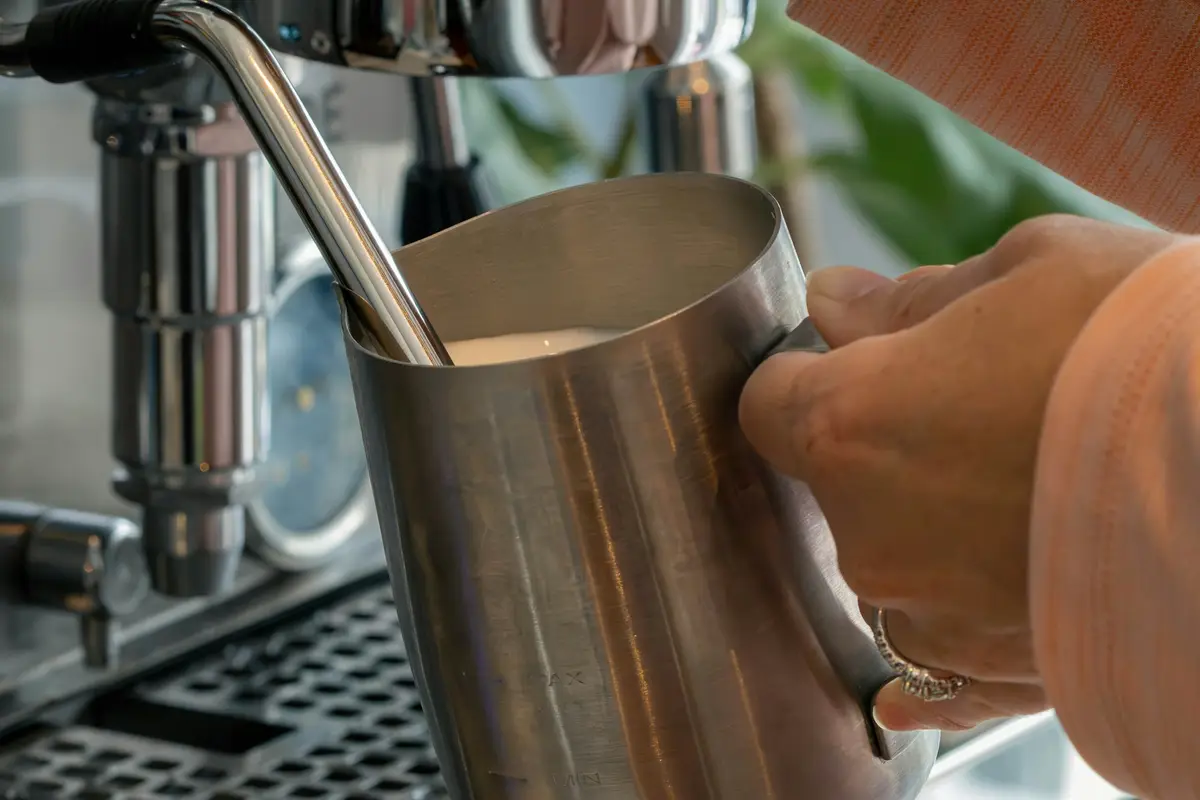
- Put the wand tip just under the surface, slightly off centre, and open the steam fully.
- Stretch: lower the jug very slightly so the tip sits at the surface and you hear a gentle tearing sound. Do this for only a few seconds, until the milk has grown by about a third for a cappuccino, less for a latte.
- Texture: raise the jug so the tip is just submerged and the milk spins in a whirlpool. Keep it spinning.
- Stop at about 60 °C (140 °F), when the jug becomes too hot to hold comfortably. Close the steam before you lift the wand out.
- Wipe and purge the wand immediately.
- Tap the jug on the counter to burst big bubbles, then swirl until the milk looks glossy.
Your first heart
Pour from a height into the centre of the espresso until the cup is about half full. Then bring the jug spout close to the surface and pour a little faster: a white circle appears. When the cup is nearly full, lift the jug and draw through the circle towards you to make a heart.
No steam wand?
An automatic frother or a fine-mesh handheld frother can make milk good enough for a latte, and some can manage simple latte art.
See the frothers we recommend: The Best Milk FrothersRead the guide